
Fall 2026 Courses
Student Hours
Mon
2:45–4:00 pm
Tue
10:00 am–12:00 pm
Wed
2:45–4:00 pm
Drop in · Noyce 2516
MAT 218: Number Theory
(Fall 2026)
- Welcome to the course webpage for MAT 218: Number Theory at Grinnell College.
Course Info
- MAT 218: Number Theory
- Fall 2026
- Section 02: MWF 10:00–10:50 AM
- Noyce 2517
- 4 Credits
Instructor Info
- Dr. Jadyn V. Breland (he/him/his)
- M/W2:45–4:00 PMTu10:00 AM–12:00 PM
- Noyce 2516 · drop in, no appointment
Mentor Sessions
- Seb, course mentor
- Tu/Th/Su 7:30–9:30 PM
- Noyce 2245
- drop in
Journal
We'll use this page to keep a short journal of each meeting. It won't contain all of the details, but will serve as a record of what transpired that day.
Entries
Week 1 · Fri, Aug 28
Meeting 1
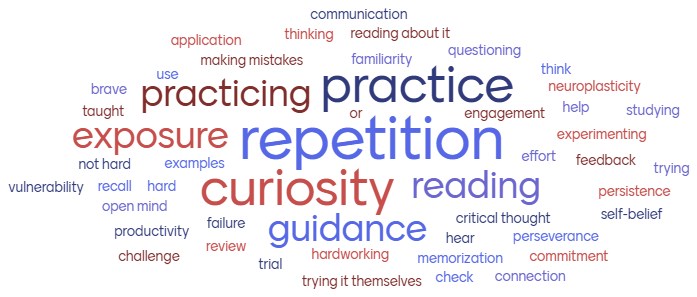
Great first day! I learned everyone's name today (and even got some of them on the first try). We spent the first few minutes discussing how learning works and the structure of the course. After a group discussion on "How does a person learn something new?" we quickly went through the most important aspects of the syllabus. Our word cloud is at the top of the page. Then we jumped into some number theory. After discussing the definition of divisibility and an Example Theorem, we split into groups and proved our first theorems. We had student presentations on Theorems 1.1, 1.2, and 1.3.
Week 2 · Mon, Aug 31
Meeting 2
Excellent day! Students presented 1.4 through 1.8, all volunteers.
In 1.4 we noticed that Friday's proof of 1.3 never used the hypothesis $a \mid c$,
which gave us 1.6 for free, and we also proved the stronger conclusion $a^2 \mid bc$.
Two conjectures came up for 1.5, both proved.
The second prompted a great discussion of the cancellation property in $\mathbb{Z}$,
which we have not proved and which the book never proves.
We agreed to accept it as a background fact about arithmetic,
so I will start a running list of allowed results and post it on the
Materials page.
We got tripped up on the characterization part of 1.8. We ran out of time for 1.9 and saved it for Wednesday.
Week 2 · Wed, Sep 2
Meeting 3
We had student presentations for 1.9, 1.10, and 1.11.
We discussed an alternative proof of 1.11 using Theorem 1.1 as well.
After that I lectured on relations and equivalence relations,
and we discussed examples and non-examples.
Finally, we established that by 1.9, 1.10, and 1.11,
congruence modulo $n$ is an equivalence relation on the set of integers.
Week 2 · Fri, Sep 4
Meeting 4
Today we had student presentations on 1.12 through 1.14.
The presenter of 1.13 caught a flaw in their initial argument,
but fixed it on the fly using previously proved theorems.
We spent some time discussing how Theorems 1.1–1.3 and 1.6
could be used to simplify various arguments used in the proofs of 1.12 through 1.14.
Then we had a student presentation on Question 1.20, which prompted the best discussion so far!
Several students came to the board and shared different types of counterexamples.
This prompted the question: which integers can be "cancelled"?
Finally, we had a student presentation on R.13.
Week 3 · Wed, Sep 9
Meeting 5
Today I discussed the precise meaning of existence and uniqueness in Theorem R.19.
Then we spent the rest of class analyzing a student's proposed proof of existence.
Next time we will see the uniqueness proof, and then we will return to studying the integers.
Week 3 · Fri, Sep 11
Meeting 6
Today, we spent the first 15 minutes taking Quiz 1.
Then we saw a student presentation of the uniqueness part of R.19.
We briefly discussed the big picture: by R.17 and R.19, every equivalence relation on a set determines a partition, and every partition comes from exactly one equivalence relation. So equivalence relations and partitions are two ways of describing the same thing.
We had a student presentation of R.20, which prompted a discussion about the well-definedness of an operation on a set of equivalence classes.
Then we had three student presentations of Exercises 1.15–1.17.
At the end, we briefly discussed how these exercises lead to the idea of induction and to a proof of Theorem 1.18.
Week 4 · Mon, Sep 14
Meeting 7
Productive day! Today we had student presentations of A.10, A.18, and A.21,
which demonstrated how to write a proof by induction.
Then we had a student presentation of Theorem 1.26,
which establishes the existence statement of the Division Algorithm.
The proof assumed there is a largest $q$ with $m \geq nq$,
which was fixed on the fly by invoking the Well-Ordering Axiom (WOA!)
on a set suggested by the audience.
Week 4 · Wed, Sep 16
Meeting 8
We started off by revisiting the main technique of the existence part of the Division Algorithm.
Then I proved that the Well-Ordering Axiom implies the Principle of Mathematical Induction.
After that, we had student presentations on 1.27, establishing the Division Algorithm for natural numbers, and then 1.28.
The presentation of 1.28 prompted a great question: does the Division Algorithm hold for the integers?
We briefly discussed Questions 1.29 and 1.30 as a class, and then had a student presentation of 1.32.
Week 4 · Fri, Sep 18
Meeting 9
Today we had student presentations of 1.33 and 1.34,
then of 1.35, which gave a precise description of the Euclidean Algorithm,
then of 1.36 and 1.37, and finally of 1.39.
The statement of the algorithm from that presentation is now in the
Allowed Results document.
Week 5 · Mon, Sep 21
Meeting 10
Today we started off with a student presentation of 1.38, then 1.40, and then 1.41.
The proof of 1.40 relied on Theorem 1.38 and established a lemma:
dividing $a$ and $b$ by their greatest common divisor results in a relatively prime pair.
This prompted a great discussion about whether 1.38 implies 1.40 and vice versa,
and how a modification of the proof of 1.38 could be used to prove 1.40.
Week 5 · Wed, Sep 23
Meeting 11
Today we had a student presentation of 1.45, followed by a separate presentation of our characterization of the integers that are cancellable modulo $n$.
After that, we had student presentations of 1.48 and 1.53.
The proof of 1.53 used M.4, the lemma I recently added to the
Allowed Results document.
With 1.53, we have finished Chapter 1, and with it we have a complete answer for linear Diophantine equations:
we know exactly when solutions exist and how to find all of them.
Week 5 · Fri, Sep 25
Meeting 12
We spent the first 20 minutes taking Quiz 2 and then discussing some of the true or false questions.
Then we had a student presentation of 2.1, which used the Well-Ordering Axiom.
We spent the rest of the class discussing 2.3.
Two students came to the board to try to work out their ideas for 2.3, although we never saw a complete proof.
Week 6 · Mon, Sep 28
Meeting 13
We opened the day by discussing the Quiz 2 corrections and a misconception related to the Euclidean Algorithm.
Then we had student presentations of three characterizations of primes: (i) implies (ii), (ii) implies (iii), and (iii) implies (i).
The presenter of (i) implies (ii) used the property “if $p \mid ab$, then $p \mid a$ or $p \mid b$” as the hypothesis instead of the textbook definition of prime,
and as a class we modified the proof on the fly.
This productive mistake led to a fourth characterization of what it means to be prime, and the audience volunteered several proof ideas.
The presenter of (ii) implies (iii) initially used hypothesis (i), but fixed their proof on the fly with input from the audience.
Finally, we had a quick student presentation of 2.7, which used strong induction.
Week 6 · Wed, Sep 30
Meeting 14
Today we had a student presentation of Lemma 2.8.
Then two students presented their ideas toward 2.9, the uniqueness part of the Fundamental Theorem of Arithmetic.
The uniqueness part is still open.
The other problems, 2.26, the strengthening of 2.27, and 2.28, were not presented.
At the end of class, we had a student presentation of the exponents part of 2.9.
Week 6 · Fri, Oct 2
Meeting 15
Productive day!
Today we started off with a student presentation of the primes part of 2.9.
Since the exponents part was handled last time, this settled the Fundamental Theorem of Arithmetic.
Then we had a student presentation of 2.28.
After that, we had student presentations of 2.19 together with 2.21, and then of 2.20.
Finally, we had student presentations of 2.22 and 2.23.
Week 7 · Mon, Oct 5
Meeting 16
We started off by discussing 2.32 as a class.
Then we had a student presentation of 2.33. The proof had a gap, and another student explained how to repair it.
Next, the presenter of 2.34 pointed out a possible gap in their own proof.
We analyzed the argument as a class, and then a student explained how to repair it.
Finally, we had student presentations of 2.35 and 2.46, establishing that there are infinitely many primes and that there are arbitrarily large gaps between consecutive primes.
Week 7 · Wed, Oct 7
Meeting 17
Today I presented a proof that there are infinitely many primes congruent to 3 modulo 4.
Then we discussed what goes wrong when we try to adapt the argument to primes congruent to 1 modulo 4.
We closed with a discussion of Dirichlet's theorem on primes in arithmetic progressions, Mersenne primes, and the open conjectures surrounding them.
Week 7 · Fri, Oct 9
Meeting 18
Today we had our first exam.
Week 8 · Mon, Oct 12
Meeting 19
We spent the first half of class discussing 3.1–3.5 as a class before a student presented an example of the algorithm in 3.6.
Then a student presented their attempt at 3.14, and we found a gap in the proof: it did not handle nonpositive integers.
Several students volunteered ideas, and although we did not close the gap, the attempts were productive.
We moved on to discuss the definition of a complete residue system as a class.
We did not get to the linear congruence material.
Week 8 · Wed, Oct 14
Meeting 20
The student from last class presented a strong second attempt at 3.14.
A small missing edge case prompted one of the best discussions of the semester, with several students bouncing ideas back and forth.
Another student came to the board and filled in the details of the missing uniqueness part of the theorem.
After this, we moved on to student presentations of 3.16 and 3.17.
The proof of 3.17 used the idea of bijective functions, which I hope to discuss next time.
| Grinnell Math | Noyce 2516 | |
|
© 2026 Jadyn V. Breland · Last updated August 2026 Views expressed are my own and do not necessarily reflect those of Grinnell College. |
||