Fall 2026 Courses
Student Hours
Mon
2:45–4:00 pm
Tue
10:00 am–12:00 pm
Wed
2:45–4:00 pm
Drop in · Noyce 2516
MAT 218: Number Theory
(Fall 2026)
- Welcome to the course webpage for MAT 218: Number Theory at Grinnell College.
Course Info
- MAT 218: Number Theory
- Fall 2026
- Section 02: MWF 10:00–10:50 AM
- Noyce 2517
- 4 Credits
Instructor Info
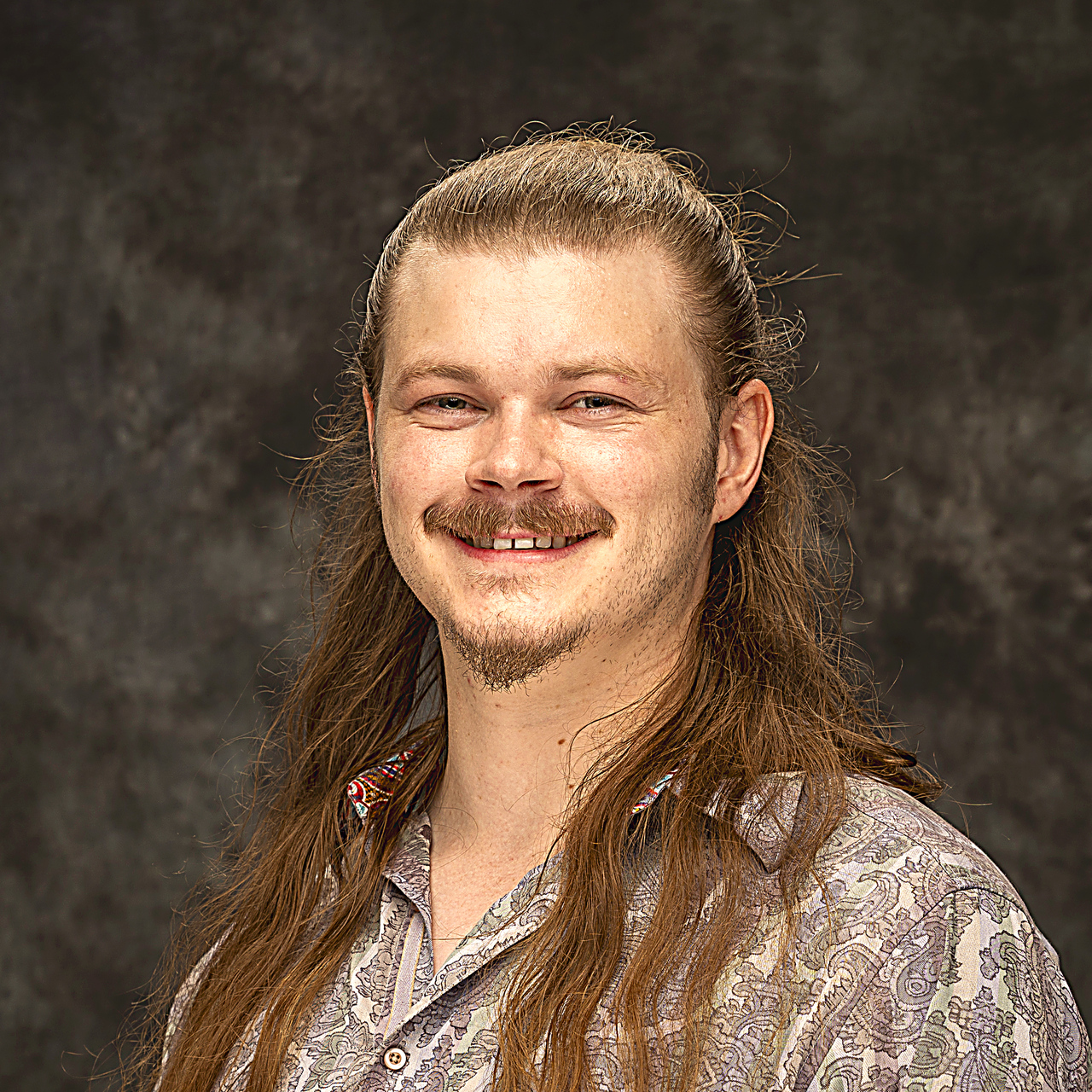
- Dr. Jadyn V. Breland (he/him/his)
- M/W2:45–4:00 PMTu10:00 AM–12:00 PM
- Noyce 2516 · drop in, no appointment
Mentor Sessions
- Seb, course mentor
- Tu/Th/Su 7:30–9:30 PM
- Noyce 2245
- drop in
Welcome!
Welcome to the Fall 2026 iteration of MAT 218 at Grinnell College! This page is specific to Section 02 of the course. If you are one of my students, I highly recommend you read the syllabus in its entirety.
Purpose and Goals
The goal of this Bridges to Advanced Mathematics course is to develop your proof-writing and creative problem-solving skills, with number theory as the backdrop. This course covers fundamental concepts in number theory, including: divisibility and congruence, linear Diophantine equations, elementary properties of prime numbers, the Fundamental Theorem of Arithmetic, the Chinese remainder theorem, Fermat's Little Theorem and Euler's Theorem, public key cryptography, primitive roots, and quadratic reciprocity. Proof writing and creative problem solving will be heavily emphasized.
Upon successful completion of the course, students will be able to recall the basic definitions, theorems, and techniques of elementary number theory; distinguish truth from falsehood, create examples/counterexamples, and formulate basic conjectures; construct concise and correct proofs, and identify flaws in proposed proofs; and communicate mathematical ideas and arguments in clear, convincing, and concise language, both written and oral.
In addition, students will further develop as independent, self-directed learners with the confidence to explore unfamiliar problems and ideas.
An Inquiry-Based Approach
This is not a lecture-driven course, nor one where mimicking prefabricated examples will ensure success. You'll be expected to actively build your own understanding of the material, with support from me, our course mentor, and your classmates. Many of the problems and ideas we'll encounter will be unfamiliar and will challenge you to think in new ways. You will experience frustration and failure before you experience understanding. This is all a part of the normal learning process. In short, if you are doing things well, you should be confused at different points over the course of the semester. The material is too rich for a human being to completely understand it immediately.
In this course, we will incorporate ideas from an educational philosophy called Inquiry-Based Learning (IBL). Roughly speaking, IBL is a student-centered method of teaching that engages students in sense-making activities and challenges them to create or discover mathematics. This style of teaching and learning contrasts sharply with the traditional mathematics lecture, where the instructor talks and students (attempt to) passively receive information.
A good lecture is usually systematic, complete, precise—and dull; it is a bad teaching instrument. -- Paul Halmos
There is a great deal of recent scholarship suggesting that students learn better when they are actively engaged in the learning process. One meta-analysis of 225 studies found that failure rates under traditional lecturing were 55% higher than under active learning. You cannot master the electric guitar by watching Buckethead shred, nor can you become a chess grandmaster by watching Magnus Carlsen on Twitch. In a similar fashion, you cannot master number theory by simply watching; you must do number theory!
Mathematics is not a spectator sport. -- George Pólya
Therefore, a significant portion of our class meetings will be reserved for doing mathematics in a supportive and collaborative environment.
We will be using the textbook Number Theory Through Inquiry, by Marshall, Odell, and Starbird. You do not need to buy the textbook; you have unlimited access online through the Grinnell College Library using that link. The textbook is designed to be used with a transition-to-proof course. It contains a sequence of questions and theorem statements without proofs; you will provide them yourself.
Class meetings will primarily consist of student-led presentations, discussion of the problems, and group work. Homework will be assigned most class meetings, announced in class and then posted here, and will primarily consist of completing problems and proving theorems from the textbook. Students are expected to complete each assignment prior to walking into the next class meeting. The significant majority of our time in class will be devoted to students presenting some subset (maybe all) of the proofs/solutions that are due that day. A meeting may also include summary of the major steps and techniques in the solution of a finished problem; exploration of alternative approaches, possible generalizations, consequences, special cases, and converses; discussion of relationships to previously assigned or solved problems; and explanation of unfamiliar mathematical concepts as needed.
Much of the structure of this course and the language on this page, as well as in the syllabus, was borrowed and/or modified from Dana C. Ernst's course materials at Northern Arizona University, which are licensed under a Creative Commons Attribution-ShareAlike 4.0 International License. This page is licensed under the same.
| Grinnell Math | Noyce 2516 | |
|
© 2026 Jadyn V. Breland · Last updated August 2026 Views expressed are my own and do not necessarily reflect those of Grinnell College. |
||