
Fall 2026 Courses
Student Hours
Research
My primary research is in the modular representation theory of finite groups, guided by the local-to-global philosophy — the principle that the representation theory of a finite group is governed by that of its p-local subgroups. I am interested in the structural invariants of splendid equivalences between blocks and the block invariants they preserve, with the ambitious goal of shedding light on Broué's abelian defect group conjecture and related problems.
Simultaneously, I have an ongoing collaborative program in algebraic combinatorics with my long-time collaborator D.C. Ernst, aimed at understanding the structure and geometry of the reduced word graph for an element of a Coxeter group. Certain pieces of this graph, which we call braid graphs, turn out to carry a surprising amount of geometric structure: they are median graphs, and therefore one-skeletons of CAT(0) cube complexes. One of my favorite things about this project is how readily it generates new questions; every bit of progress I make on one question tends to open up several more.
Modular Representation Theory
-
Brauer pairs for splendid Rickard equivalences
Abstract
We define the notion of a Brauer pair of a chain complex, extending the notion of a Brauer pair of a \(p\)-permutation module introduced by Boltje and Perepelitsky. We prove that the Brauer pairs of a splendid Rickard equivalence \(C\) coincide with the set of Brauer pairs of the corresponding \(p\)-permutation equivalence \(\Lambda(C)\) induced by \(C\). As a result, we derive structural results for splendid Rickard equivalences that correspond to known structural properties for \(p\)-permutation equivalences. In particular, we show splendid Rickard equivalences induce local splendid Rickard equivalences between normalizer block algebras as well as centralizer block algebras.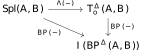
-
Splendid relatively stable equivalences for blocks of finite groups
Summary
This work characterizes splendid relatively stable equivalences in terms of their local pieces, generalizing Rouquier's work on splendid stable equivalences. It establishes a framework to detect relative stable equivalences by checking derived equivalences on specific local levels determined by the Brauer pair poset.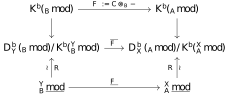
Algebraic Combinatorics
-
Braid graphs in simply-laced triangle-free Coxeter systems are partial cubes
Abstract
We study the structure of braid graphs in simply-laced Coxeter systems. We prove that every reduced expression has a unique factorization as a product of so-called links, which in turn induces a decomposition of the braid graph into a box product of the braid graphs for each link factor. When the Coxeter graph has no three-cycles, we use the decomposition to prove that braid graphs are partial cubes, i.e., can be isometrically embedded into a hypercube. For a special class of links, called Fibonacci links, we prove that the corresponding braid graphs are Fibonacci cubes.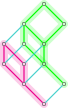
-
Braid graphs in simply-laced triangle-free Coxeter systems are median
Abstract
In this paper, we will provide an alternate proof that braid graphs in simply-laced triangle-free Coxeter systems are partial cubes, as well as determine the minimal dimension hypercube into which a braid graph can be isometrically embedded. For our main result, we prove that braid graphs in simply-laced triangle-free Coxeter systems are median, which is a strengthening of previous results.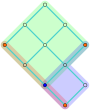
-
Braid graphs in simply-laced triangle-free Coxeter systems and ribbon polyomino lattices
Dissertation
-
Brauer pairs for chain complexes: splendid Rickard and relatively stable equivalences
Abstract
Let \(G\) be a finite group and let \(F\) be an algebraically closed field of prime characteristic \(p > 0\). We associate to each bounded chain complex \(C\) of \(p\)-permutation \(FG\)-modules a \(G\)-poset of Brauer pairs, generalizing the Brauer pair theory of Boltje and Perepelitsky for \(p\)-permutation modules and refining their theory for virtual \(p\)-permutation modules. We give sufficient conditions for this poset to be an ideal and show that in this case, the maximal elements control the vertices of the constituents of \(C\). When \(C\) is a splendid Rickard equivalence between blocks of finite group algebras, we show that the Brauer pairs in the poset are precisely those at which the Brauer functor induces a splendid Rickard equivalence between the corresponding blocks of local subgroups, both at the centralizer and at the normalizer level. Furthermore, we show that the poset is an ideal, that there is a unique conjugacy class of maximal elements, and that any choice of maximal element determines an isomorphism of defect groups and fusion systems with respect to which the vertices of the constituents of \(C\) are diagonal. We also show that this poset coincides with the poset of Brauer pairs for the corresponding \(p\)-permutation equivalence. Finally, we introduce the notion of a splendid relatively stable equivalence between blocks and use the theory of Brauer pairs to provide a local-to-global characterization of these equivalences, generalizing a theorem of Rouquier.
| Grinnell Math | Noyce 2516 | |
|
© 2026 Jadyn V. Breland · Last updated August 2026 Views expressed are my own and do not necessarily reflect those of Grinnell College. |
||